
Here's something that surprises a lot of event organizers: adding a second speaker can make a show sound worse. Thinner. Hollow. Like someone scooped the middle out of the music. It's not bad gear and it's not a bad mix. It's physics, and it has a name: phase.
This is the part of live sound nobody sees, and it's one of the biggest differences between a PA that's simply turned on and a PA that's actually tuned. Here's how it works, without the textbook.
Sound is a wave, and waves can cancel
Every sound is air being pushed and pulled, over and over. A speaker cone moves forward (push) and back (pull) hundreds or thousands of times a second. When two speakers play the same sound, those pushes and pulls meet in the air.
- If the pushes arrive together, they add up. Two equal speakers perfectly in step get you about 6 dB louder, which sounds like a real jump in level.
- If one speaker's push arrives during the other's pull, they fight. At the worst point they cancel almost completely, and that frequency just disappears.
"In phase" means the waves line up. "Out of phase" means they don't. Most of the time it's somewhere in between, and that's where the trouble hides.
The one formula worth memorizing
Sound in air travels about 1,130 feet per second. Divide that by a thousand and you get the rule every system engineer carries around:
Sound travels about 1 foot every millisecond.
So if one speaker is 5 feet farther from you than another, its sound shows up about 5 milliseconds late.
Five milliseconds sounds like nothing. To a sound wave, it's everything. Here's the formula that turns a delay into a problem:
First cancellation = 1 ÷ (2 × delay)
A 1 ms delay (about one foot) wipes out sound right around 500 Hz, the meat of vocals and guitars. Then it hits again at 1,500 Hz, 2,500 Hz, and up the line.
That repeating pattern of holes is called comb filtering, because on a measurement screen it looks like the teeth of a comb. It's why a voice can sound like it's coming through a tube when you stand in the wrong spot between two speakers.
Why bass is the big one
Low notes have long waves. A wave's length is just the speed of sound divided by the frequency:
Wavelength = 1,130 ÷ frequency
At 100 Hz, one wave is about 11 feet long. At 1,000 Hz, it's about 1 foot.
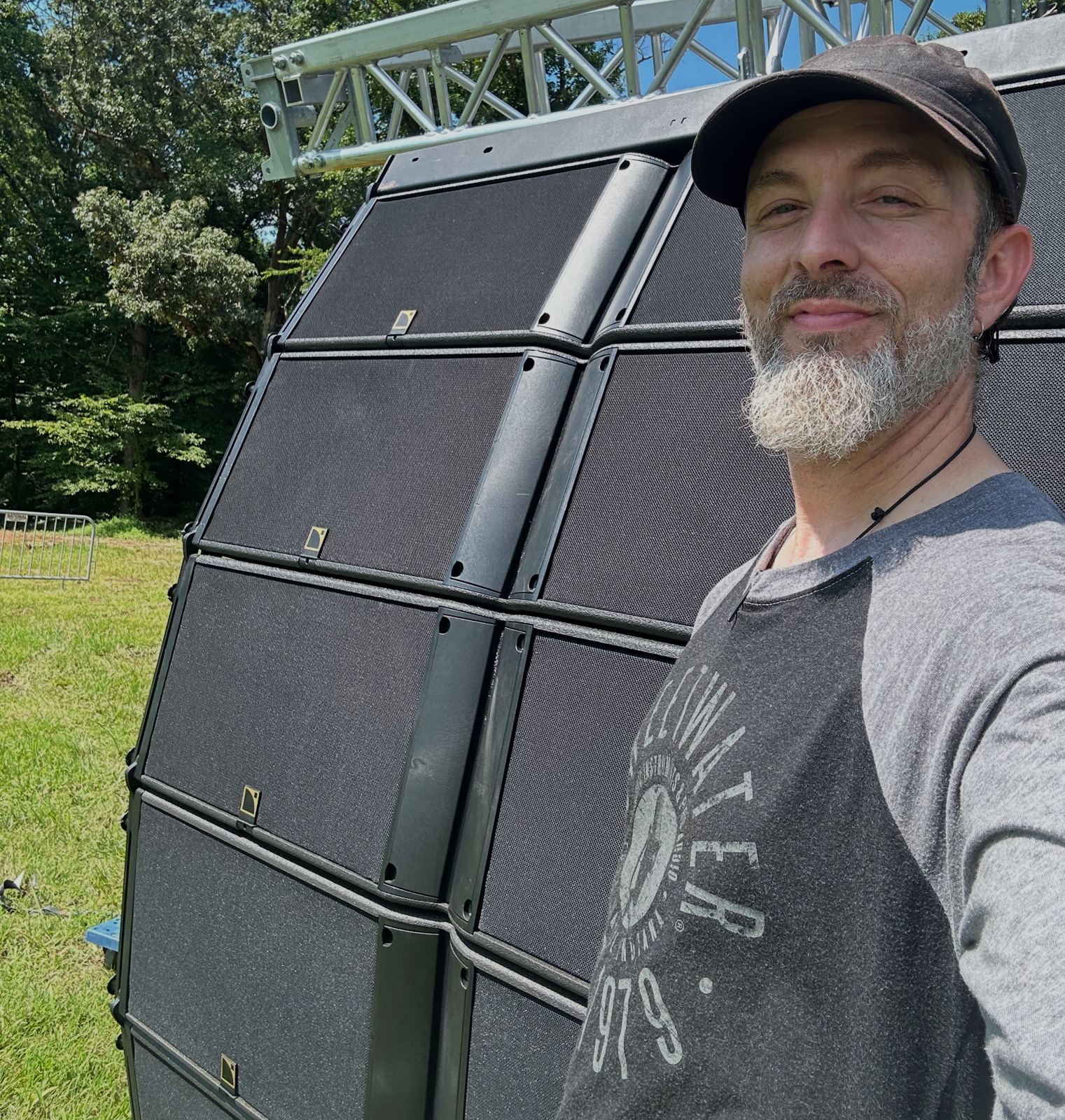
Most concert systems hand the bass off from the main speakers to the subwoofers somewhere around 80 to 120 Hz. That crossover is exactly where the subs and mains are both playing at once. If the subs sit on the ground and the mains hang 20 feet in the air, the two sounds take different paths to the audience. Get them half a wave out of step, about 5 or 6 feet of path difference at 100 Hz, and the kick drum's punch cancels right where it should hit hardest.
That's the "why does this huge system have no punch?" problem. Nine times out of ten, the subs and mains are fighting at the crossover.
Here's the curveball: temperature
The speed of sound isn't fixed. It changes with the air:
Speed of sound (ft/s) ≈ 1,052 + 1.1 × temperature (°F)
At a 90°F soundcheck, sound moves about 1,151 ft/s. At 50°F after sunset, about 1,107 ft/s.
That's about a 4% change, and it adds up over distance. A delay tower 100 feet out from the stage can drift more than 3 milliseconds out of time between a hot afternoon line check and a cool mountain night. In Western North Carolina, where the temperature can drop 30 degrees from soundcheck to the headliner, that's not theory. We check it.
When a PA needs phase alignment
Not every gig does. Here's our honest checklist.
You need it when:
- Subs and mains are in different places, like ground-stacked subs under a flown line array. This is the most common one and the most important.
- You're using delay speakers or towers for a big field or a long street. They have to be timed to the stage, or the back half of the crowd hears an echo.
- There are front fills or side fills covering the people up close, overlapping with the mains.
- Two speaker stacks cover the same seats, like left and right stacks in a wide space.
- You're mixing different speaker models, since each one has its own built-in timing.
You can usually skip it when:
- It's one speaker (or one pair) for speech in a small room.
- Each speaker covers its own area with very little overlap.
- The system is a single matched package already aligned by the manufacturer's presets, set up the way it was designed.
How we actually do it
We don't guess. We measure with Smaart, the measurement software most touring engineers use. A measurement microphone goes out where the audience will be, and Smaart compares what the console sent with what the mic actually heard.
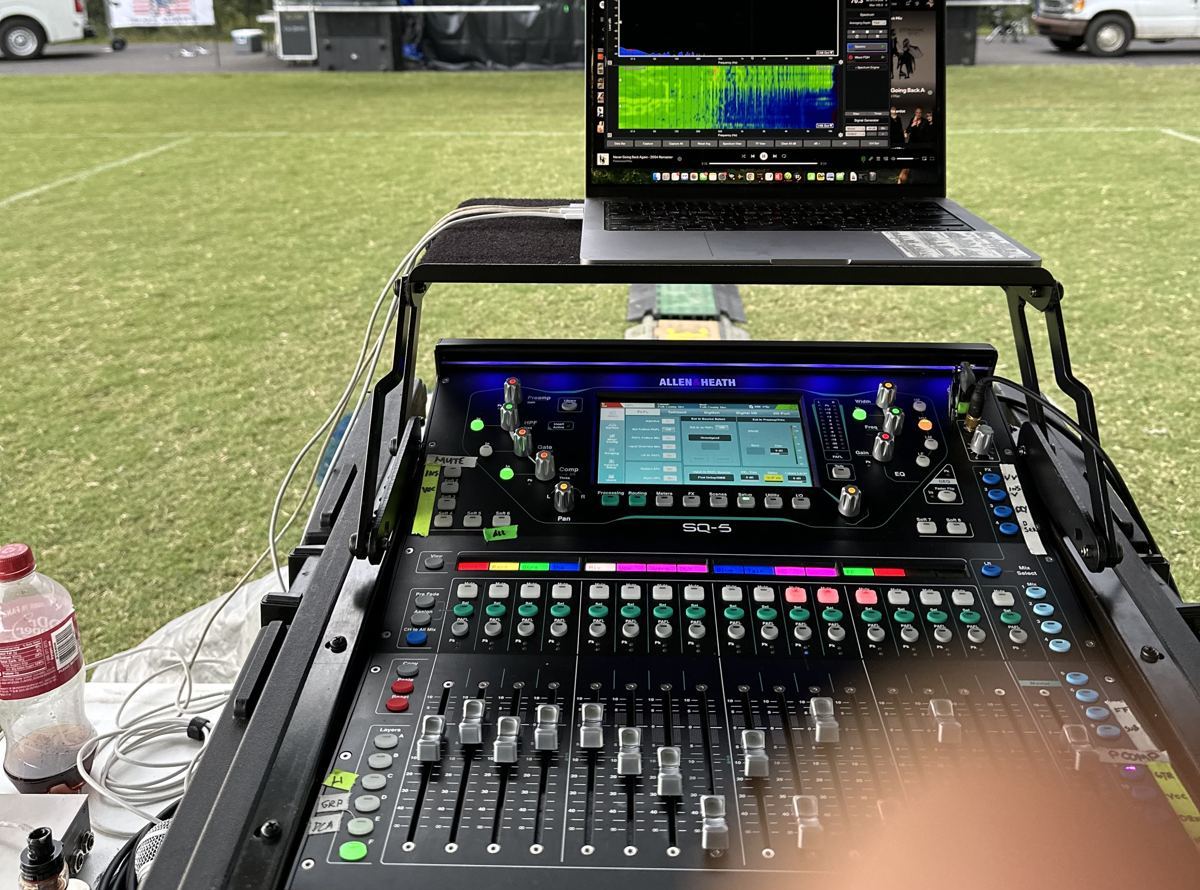
That comparison shows us three things a pair of ears can't:
- The exact arrival time of each speaker, down to a fraction of a millisecond.
- The phase of each speaker at every frequency, so we can see whether the subs and mains agree through the crossover.
- Coherence, which tells us whether we're measuring the PA or just wind and crowd noise. Outdoors, that matters.
Then we add tiny bits of delay in the system processor until the speakers line up where it counts. For delay towers, we time them to the stage and add a few extra milliseconds on purpose. Your ears decide where a sound comes from by whatever arrives first, so a touch of extra delay keeps the crowd's attention on the stage instead of on the tower beside them.
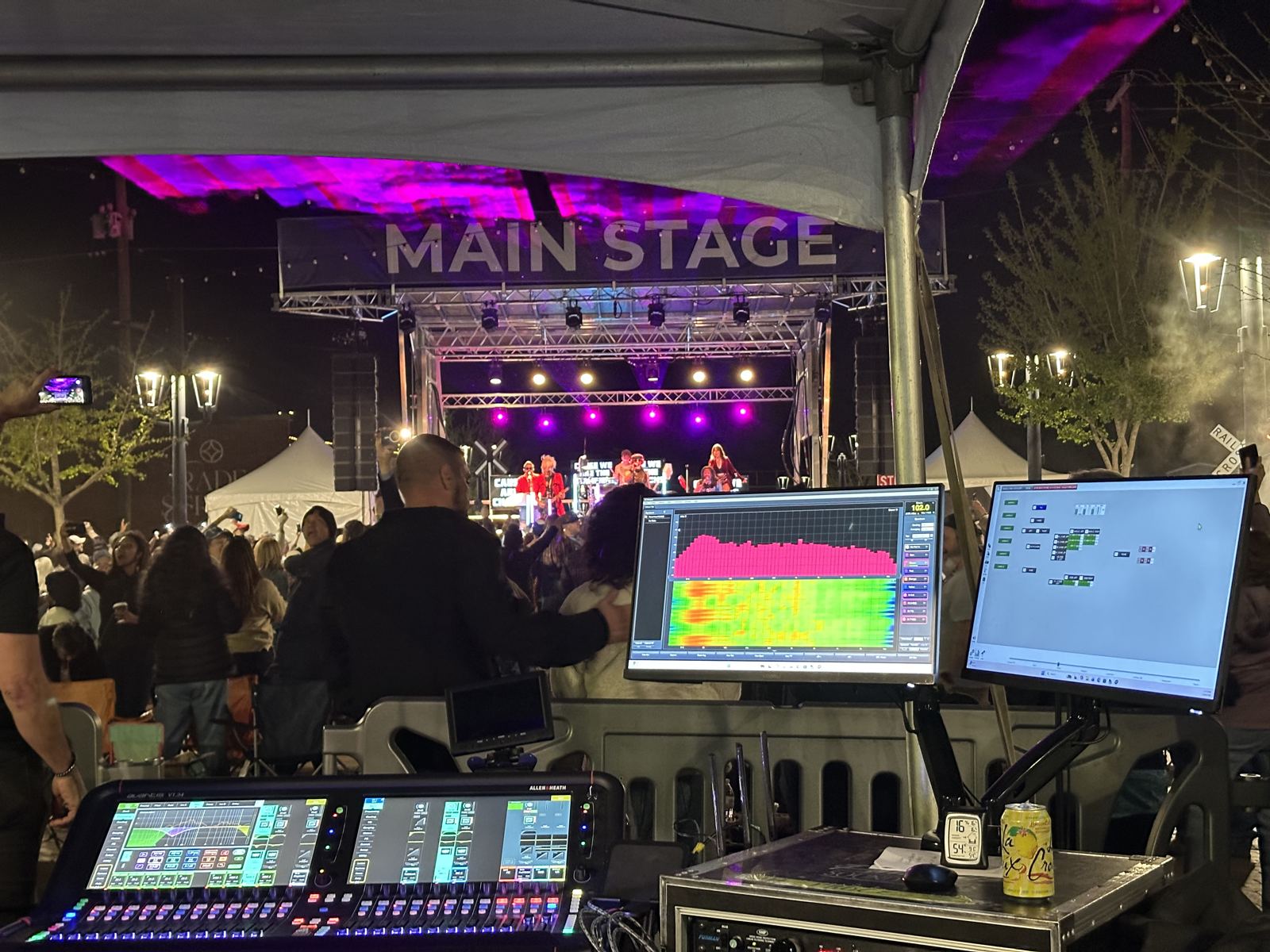
The result isn't always "louder." It's fuller: the kick drum lands, vocals sit forward, and the back of the crowd hears the same show as the front.
The short version
- Sound travels about 1 foot per millisecond. Small distances make big differences.
- Speakers out of step cancel each other, especially in the bass.
- Subs, delays, and fills need to be timed to the main system.
- Temperature changes the timing, so outdoor shows get checked again as the night cools.
- A measured system sounds fuller, clearer, and more even across the crowd.
If you're planning a show and want a PA that's tuned instead of just turned on, build your show and tell us about the space. We'll bring the mic.
Planning an event? Build your show and Barbie will follow up with a quote.